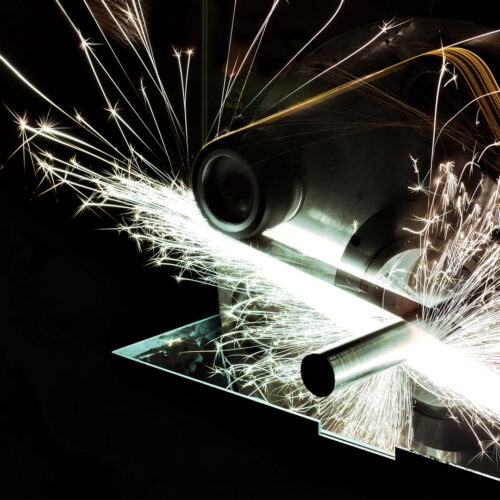
Garboli metal deburring machines remove burrs from tube and profile ends and from sheet-metal edges. A cut-end deburring machine treats the workpiece perimeter; a sheet-metal deburring system addresses edges and contours of a flat part. Dedicated brush contact and feed arrangements serve these different geometries. Burr removal and edge rounding are related but separate requirements.
All Deburring machines
GPS Orbital
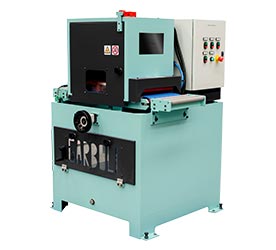 Deburring machines
GPS Orbital
“Wet” orbital deburring machine
ROTOR 200 WET
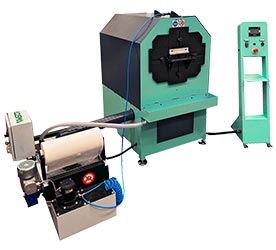 ROTOR 200 WET
Tube and profile end deburring
Cutting or machining may leave burrs at the inside or outside of a tube end. Suitable orbital brush deburring machines configuration work around the cut perimeter of round, square and selected irregular sections. Cross-section, wall thickness, cut angle and required edge condition determine the contact arrangement.
Selected wet configurations use coolant and filtration. Brush type, speed, section capacity and angled-cut compatibility depend on the chosen machine and process.
Sheet-metal edges and flat workpieces
Dedicated sheet-metal deburring units remove burrs left along cut edges and contours. Selected configurations also round edges or treat an adjacent surface. Grinding or satin finishing of the broad face may require other tools or working units; burr removal alone does not define the finished face texture.
The available configurations include round-workpiece diameters of 10–210 mm and square sections of 10–148 mm. Selected sheet and flat-workpiece machines cover widths of 10–300 mm and thicknesses of 1–150 mm, with feed rates of 1–10 m/min. These are separate working ranges for different machines, subject to the specifications of the chosen configuration.
Define the required edge condition
Selection starts with material, geometry, the operation that produced the burr and the required result. A representative part helps establish brush contact and material removal, particularly where edge rounding must stay within the component specification.
Garboli Range deburring applications distinguish tube and profile ends from sheet-metal edges. Any following surface-preparation or finishing stages must be specified separately.
Frequently asked questions
Deburring removes protruding residual material. Edge rounding changes the edge profile; it is a separate result that requires suitable tools and process settings.
Selected configurations treat both at the cut end. Section, wall thickness and cut angle determine the suitable arrangement.
Selected configurations provide adjacent-surface treatment. A specified face texture may need separate grinding or finishing tools and units.
No. The quoted diameter, section, width, thickness and feed intervals describe different machines and setups. Each configuration has its own specifications.
The starting points are workpiece material, geometry and dimensions, the process that produced the burr, and the required edge condition. For tubes and profiles, cross-section, wall thickness and cut angle matter; for sheet metal, width, thickness and contour shape matter. These parameters determine the brushes, workpiece support and feed system.